
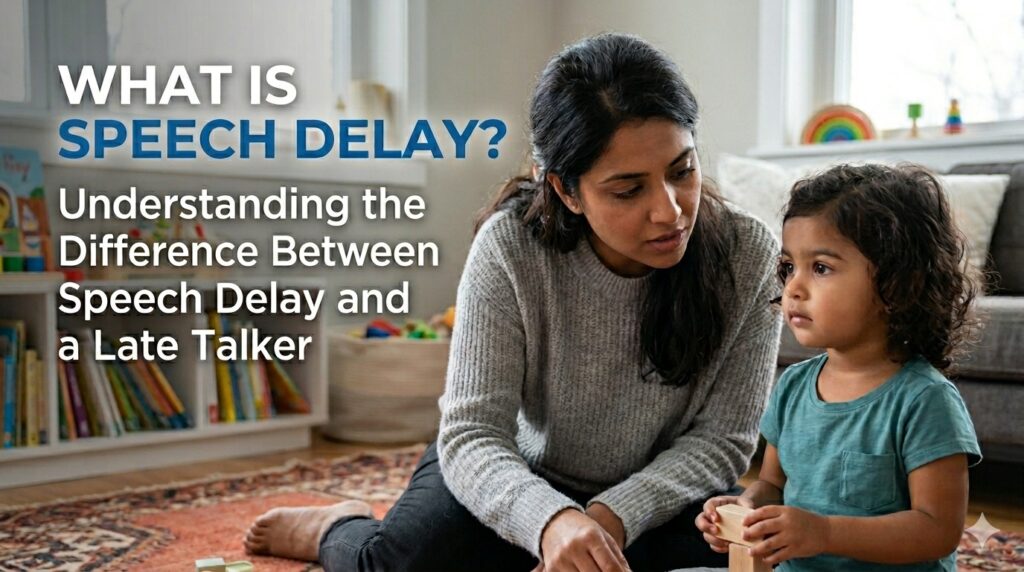
Many parents begin to worry when their child is not speaking as much as other children of the same age. Questions like “Is my child just a late talker?” or “Does my child have a speech delay?” are very common.
While every child develops at their own pace, understanding the difference between speech delay and late talking can help parents determine when additional support may be helpful.
In this article, we explore what speech delay means, how it differs from late talking, and when parents should consider seeking professional guidance.
Speech delay refers to a condition where a child’s speech development follows the normal sequence but progresses at a slower rate than expected for their age.
Children with speech delay may:
Speech delay mainly involves speech production, which includes the ability to form sounds, pronounce words, and communicate verbally.
For example, by 2 years old, most children are expected to:
If a child is not reaching these milestones, it may indicate a speech delay.
However, it is important to understand that speech delay does not always mean there is a serious developmental problem. Some children simply need extra time or support to develop their communication skills.
A late talker is a toddler who starts speaking later than peers but otherwise shows typical development in other areas, such as understanding language, social interaction, play skills, and motor development.
Late talkers usually:
Many late talkers begin speaking more actively between 2.5 to 3 years old and gradually reach similar language levels as their peers.
Research suggests that approximately 10–15% of toddlers are late talkers, but many eventually catch up without long-term language difficulties.
Although the two terms sound similar, they describe different developmental patterns.
Late Talker | Speech Delay |
Speech starts later than peers | Speech development is slower than expected |
Good understanding of language | May have difficulty understanding language |
Uses gestures to communicate | May rely less on gestures |
Social interaction usually strong | Social communication may be affected |
Often catches up naturally | May require professional intervention |
The key difference is that late talkers typically show strong understanding and social communication, while children with speech delay may show broader communication difficulties.
Speech delay can occur for many different reasons. Some common factors include:
Children need to hear sounds clearly in order to learn speech. Frequent ear infections or hearing problems can affect speech development.
Speech delay may be associated with broader developmental delays.
Children with autism may experience challenges in communication, social interaction, and language development.
Some children may have difficulty coordinating the muscles used for speech.
Limited opportunities for interaction, conversation, and language stimulation may also contribute to delayed speech.
It is important to note that every child is different, and identifying the underlying cause requires professional assessment.
Parents should consider seeking professional advice if their child:
Early identification allows children to receive support during the critical early years of brain development, when intervention is most effective.
Early intervention programs play a crucial role in supporting children with communication difficulties.
Through structured activities and individualized support, early intervention can help children:
At Apple King Special Education Centre, we adopt a multidisciplinary and brain-based approach to support children with speech and language challenges. Our programs integrate:
Every child learns differently, and our goal is to create customized learning pathways that support each child’s strengths and needs.
It is natural to feel concerned if your child is not speaking as much as other children. However, speech development varies widely among young children.
Some children are simply late talkers who will catch up naturally, while others may benefit from early support to strengthen their communication skills.
The most important step is early observation and timely guidance. If you have concerns about your child’s speech development, consulting professionals can provide clarity and reassurance.
Remember: early support can make a significant difference in a child’s communication and learning journey.
Bishop, D. V. M., & Snowling, M. J. (2004). Developmental dyslexia and specific language impairment: Same or different? Psychological Bulletin, 130(6), 858–886.
Rescorla, L. (2002). Language and reading outcomes to age 9 in late-talking toddlers. Journal of Speech, Language, and Hearing Research, 45(2), 360–371.
Roberts, M. Y., & Kaiser, A. P. (2011). The effectiveness of parent-implemented language interventions. American Journal of Speech-Language Pathology, 20(3), 180–199.
Zubrick, S. R., Taylor, C. L., Rice, M. L., & Slegers, D. W. (2007). Late language emergence at 24 months. Journal of Speech, Language, and Hearing Research, 50(6), 1562–1592.
+6010-207 1838
applekingbrainscience@gmail.com