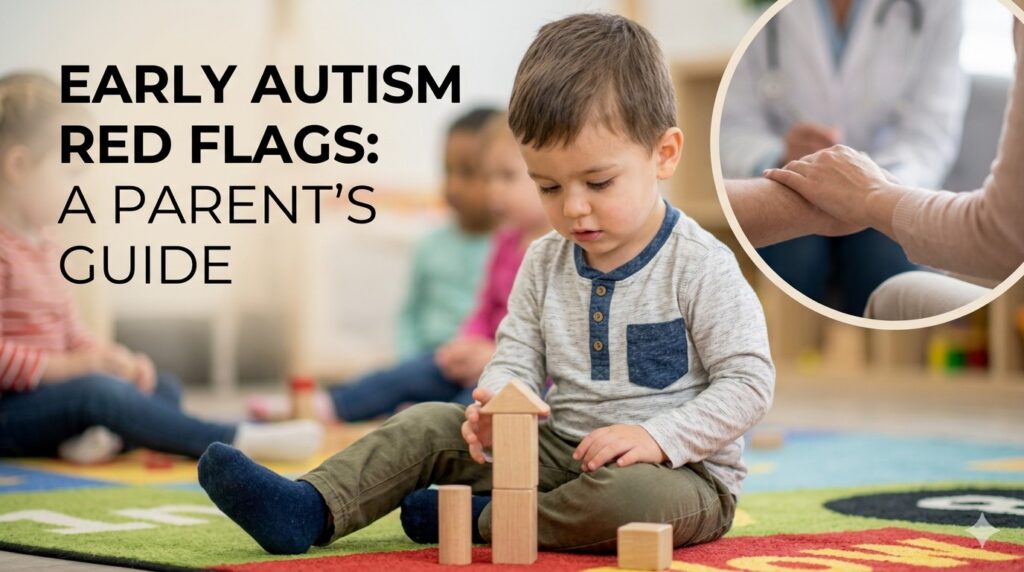
Autism Spectrum Disorder (ASD) is a developmental condition that affects how a child communicates, interacts socially, and experiences the world around them. Autism is called a “spectrum” because it presents differently in every child — some children may need significant support, while others may function quite independently.
In recent years, awareness of autism has increased worldwide. According to the World Health Organization, about 1 in 100 children globally are estimated to have autism. Early identification and intervention are key factors that help children reach their full developmental potential.
Understanding the early signs (red flags) of autism can help parents seek support early and provide their child with the appropriate guidance and intervention.
Autism Spectrum Disorder is a neurodevelopmental condition, meaning it affects how the brain develops and processes information. Children with autism may experience challenges in three main areas:
Children may have difficulty with:
Some children may:
Children with autism may show:
According to the American Psychiatric Association in the Diagnostic and Statistical Manual of Mental Disorders (DSM‑5), autism is diagnosed based on persistent challenges in social communication and restricted or repetitive behaviors.
Every child develops at their own pace. However, certain behaviors may indicate that a child could benefit from further developmental screening.
Parents may want to pay attention if their child shows several of the following signs:
Some children with autism may be:
It is important to remember that having one or two signs does not necessarily mean a child has autism, but a pattern of several signs may indicate the need for professional evaluation.

If parents notice developmental concerns, early action can make a significant difference. Here are several steps parents can take:
Parents may start by observing their child’s behavior and developmental milestones. Keeping simple notes or videos can help professionals better understand the child’s behavior.
The first step is usually discussing concerns with a pediatrician. The doctor may recommend developmental screening or refer the child to specialists such as:
A comprehensive assessment helps determine whether a child meets the criteria for Autism Spectrum Disorder or other developmental conditions.
Early diagnosis allows families to access appropriate support services.
Research consistently shows that early intervention significantly improves outcomes for children with autism. Early intervention programs may include:
Programs are often individualized to meet each child’s unique needs.

Early intervention focuses on supporting a child’s development during the most important period of brain growth — the early childhood years.
Studies have shown that early intervention can help children:
The National Institute of Child Health and Human Development emphasizes that early intervention services can greatly improve developmental outcomes for children with autism.
Discovering that your child may have developmental differences can feel overwhelming for many parents. However, autism is not a limitation on a child’s potential. With the right support, guidance, and environment, children with autism can learn, grow, and thrive.
Many children who receive early support go on to participate successfully in school and community life.
The most important message for parents is this: trust your observations and seek help early. Early awareness opens the door to early support — and early support makes a meaningful difference in a child’s development.
American Psychiatric Association. (2013). Diagnostic and statistical manual of mental disorders (5th ed.).
Lord, C., Brugha, T. S., Charman, T., et al. (2020). Autism spectrum disorder. Nature Reviews Disease Primers.
Zwaigenbaum, L., et al. (2015). Early intervention for children with autism spectrum disorder. Pediatrics.
World Health Organization. (2023). Autism spectrum disorders.


